
Veterinarians have been documenting grape toxicity in dogs since 1998. Over 25 years of cases. And we still don’t know exactly what makes them deadly.
That’s not a comfortable thing to say. But it’s the truth. The scientific literature is clear that grapes — fresh, dried, juiced, or fermented — can cause acute kidney failure in dogs. What remains unknown is the exact mechanism. Which compound triggers it. Why some dogs seem unaffected while others deteriorate within 24 hours.
The short answer: No, dogs cannot eat grapes. Not even one. Treat any grape exposure as a medical emergency.
Dog Ate Grapes Right Now? Do This in the Next 2 Hours
Speed matters more than almost anything else here. Kidney damage from grape toxicity can begin within hours, and early intervention dramatically improves outcomes.
- Call your vet or an emergency animal hospital immediately. Don’t wait to see if symptoms develop.
- Call ASPCA Animal Poison Control: (888) 426-4435. They are available 24/7. There may be a consultation fee.
- Note what your dog ate. How many grapes or raisins, what form (fresh, dried, juice), and when. This helps the vet decide whether to induce vomiting.
- Do not induce vomiting unless instructed. A vet needs to make that call based on timing and your dog’s condition.
- Do not give food or water until you’ve spoken to a professional.
The window for effective decontamination is roughly 2 hours. After that, absorption increases and treatment becomes more complicated.
What Happens Inside a Dog’s Body
The kidneys are the primary target. Cornell’s College of Veterinary Medicine describes a progression that moves faster than most owners expect.
Within 6 to 12 hours: vomiting, diarrhea, lethargy. These early signs are easy to dismiss or attribute to something else. Many owners wait here, and that wait costs time.
Within 24 to 48 hours: the kidneys begin to fail. The dog stops producing urine (oliguria) or stops entirely (anuria). Toxins that the kidneys would normally filter out start accumulating in the bloodstream.
After 48 hours: severe cases show abdominal pain, tremors, seizures, and loss of coordination. At this stage, the prognosis worsens significantly.
Aggressive IV fluid therapy — started early — can flush the toxin and support kidney function. Dogs treated within the first few hours have a much higher survival rate. Dogs that develop anuria before treatment often don’t recover.
All Grape Forms, Ranked by Danger
Not all grape products carry equal risk. Here’s how they stack up:
Fresh Grapes
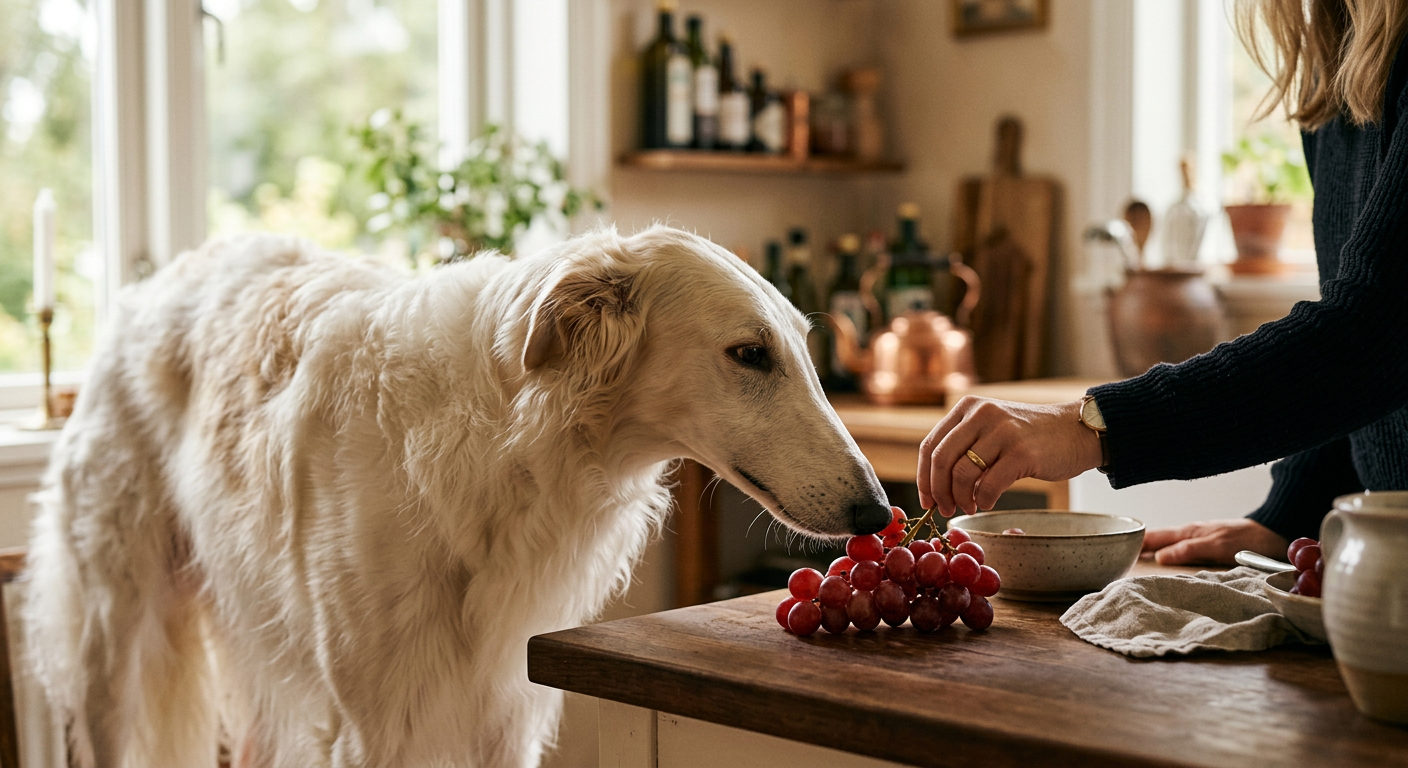
Dangerous. A Borzoi could theoretically eat a small handful and show no symptoms. But another Borzoi could eat two grapes and end up in renal failure. The inconsistency is documented and unexplained. There is no known safe dose.
Raisins, Currants, and Sultanas
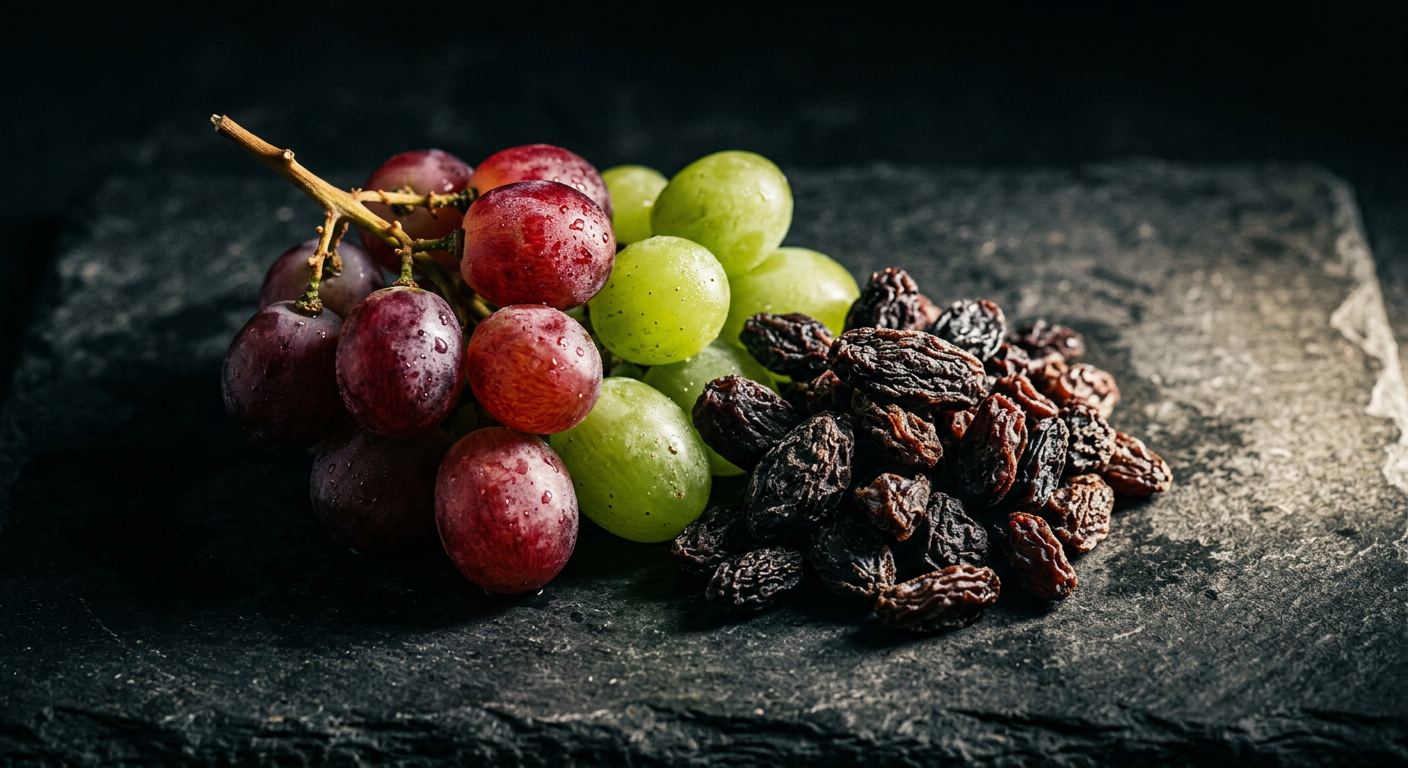
More dangerous than fresh grapes by weight. Drying concentrates whatever compound causes toxicity. The ASPCA lists raisins as one of the most common serious pet toxins. A single raisin per pound of body weight has caused kidney failure in some reports. A small box of raisins could kill a medium-sized dog.
Grape Juice and Wine
The toxicity risk is still present, though the concentration is lower than in solid grapes. Wine also adds alcohol toxicity into the mix. Neither is safe for dogs under any circumstances.
Grape-Flavored Products
Products artificially flavored with grape but containing no actual grape are generally considered low-risk — but read labels carefully. “Grape flavor” from real grape extract is different from synthetic flavoring.
The Inconsistency Puzzle: Why Do Some Dogs Survive?
This is what makes grape toxicity so unsettling as a veterinary problem.
Some dogs eat grapes repeatedly with no apparent harm. Others go into acute renal failure after a single exposure. There’s no predictive pattern based on breed, size, age, or health status. A large dog is not safer than a small one. A young healthy dog is not guaranteed to survive what an older dog survived.
The leading current theory points to tartaric acid. Grapes are unusually high in it, and dogs appear to be sensitive to it in ways that other species are not. Some dogs may metabolize it differently, which could explain why individual responses vary so dramatically. But this is still a working hypothesis, not a confirmed mechanism.
What the uncertainty means practically: you cannot look at your dog and calculate risk. You cannot say “she’s big, she’ll be fine” or “it was just one.” The only rational response to any grape ingestion is to treat it as an emergency — every time.
Hidden Grape Sources You Might Not Think Of
Fresh grapes are easy to spot. These aren’t:
- Trail mix — almost always contains raisins
- Fruitcake and holiday breads — currants and sultanas are standard ingredients
- Granola bars and cereals — many contain raisins as a standard ingredient
- Bagels and cinnamon raisin bread — one slice can contain a significant raisin load
- Juice boxes and fruit pouches — often grape juice or grape-juice blends
- Mince pies and Christmas pudding — dense with currants and sultanas
- Some protein or energy bars — check the ingredient list
Holiday seasons are particularly high-risk. If your dog gets into baked goods or snack mixes left out during gatherings, assume grapes or raisins may be present until you can verify otherwise.
What NOT to Do
A few things people do that make the situation worse:
Wait and see. Symptoms can take hours to appear, by which point kidney damage may already be underway. “She seems fine” does not mean she is fine.
Induce vomiting without guidance. In some cases this is appropriate. In others — if the dog is already showing neurological symptoms, or if too much time has passed — it can cause additional harm. Let a professional make this call.
Give milk or food to “neutralize” the poison. This doesn’t work and may delay proper treatment.
Search online for a “safe amount.” There isn’t one. The research doesn’t support any minimum safe dose.
If you’re wondering which fruits are safe for dogs, strawberries and blueberries are among the options with good safety records — a sharp contrast to grapes. And if you want another example of a food that’s more dangerous than it looks, avocado carries its own serious risks.
FAQ
My dog ate one grape — should I panic?
Don’t panic, but do act. Call your vet or ASPCA Poison Control (888-426-4435) right now. One grape has caused kidney failure in documented cases. The dose-response relationship in dogs is not well understood, and individual sensitivity varies widely. Early treatment — even if it turns out to be unnecessary — is far better than waiting.
Are raisins more dangerous than grapes?
Yes, by weight. Raisins are dehydrated grapes, which concentrates whatever the toxic compound is. This means a much smaller amount of raisins can cause the same level of toxicity as a larger quantity of fresh grapes. Currants and sultanas carry the same risk.
What are the first signs of grape poisoning?
Vomiting is usually the first sign, often within a few hours of ingestion. This may be followed by diarrhea, lethargy, loss of appetite, abdominal tenderness, and decreased urination. The problem is that these early symptoms are easy to attribute to an upset stomach — which is exactly why grape ingestion needs to be treated proactively, not reactively.
My dog ate grapes last week and seems fine — is he okay?
Possibly, but worth a vet check. Some dogs do survive grape exposure without apparent harm, for reasons that aren’t fully understood. That said, subclinical kidney damage can occur without visible symptoms. A basic kidney panel (BUN, creatinine, phosphorus) can tell you whether kidney function is normal. If it was a significant amount, a vet visit is strongly recommended even if your dog appears healthy.